Oil markets are once again trending upward as negotiations between the US and Iran show little sign of progress.
After a short period of relief, rising crude prices are expected to feed through into higher fuel surcharges—adding renewed pressure on global logistics costs.
For multimodal logistics providers, this creates a particularly difficult environment to manage. Fuel surcharges are not uniform; they differ significantly depending on transport mode, specific trade lanes, and even individual carriers. This variability makes cost forecasting and pricing consistency increasingly challenging.
There is often a delay between movements in oil prices and what is ultimately reflected in fuel surcharges. This adds another layer of complexity, especially when communicating changes to customers In the UK, for instance, some transport surcharges have recently fallen despite a renewed upswing in oil prices, highlighting the disconnect.
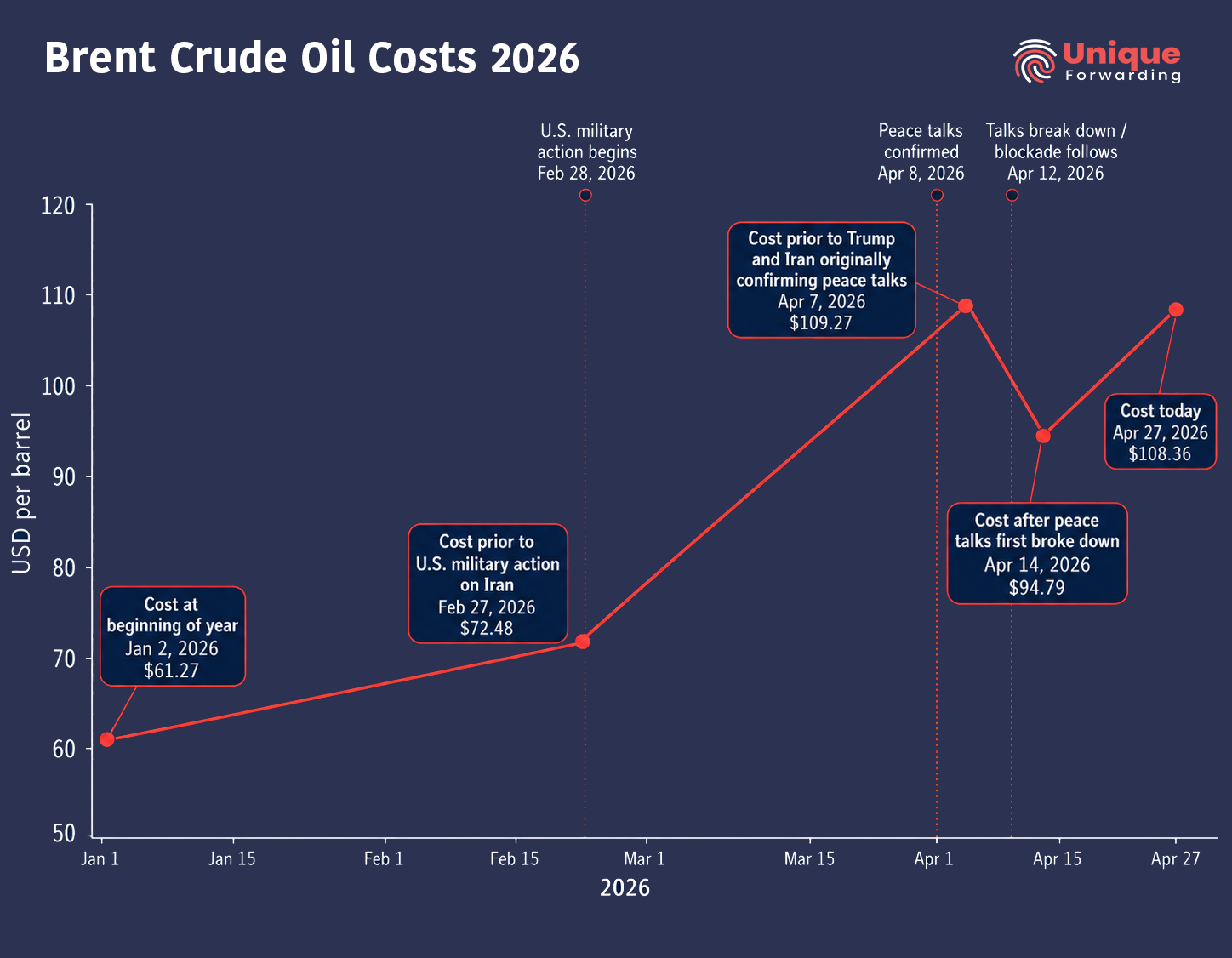
At the center of these fluctuations is Brent crude, the primary global benchmark for oil pricing. As the chart illustrates, its price movements have been anything but stable, with sharp rises and falls closely tied to geopolitical developments—particularly those involving the Middle East.
It’s also worth noting that not all fuel types perfectly mirror Brent crude. Diesel, jet fuel, and bunker fuel each follow their own supply chains and market dynamics, which can cause their pricing to diverge at times.
Even so, Brent crude remains a strong barometer of overall market direction. With geopolitical tensions persisting and little indication of a breakthrough in US–Iran talks, the outlook suggests that elevated oil prices—and the resulting fuel surcharges—are likely to remain a factor in the near term.